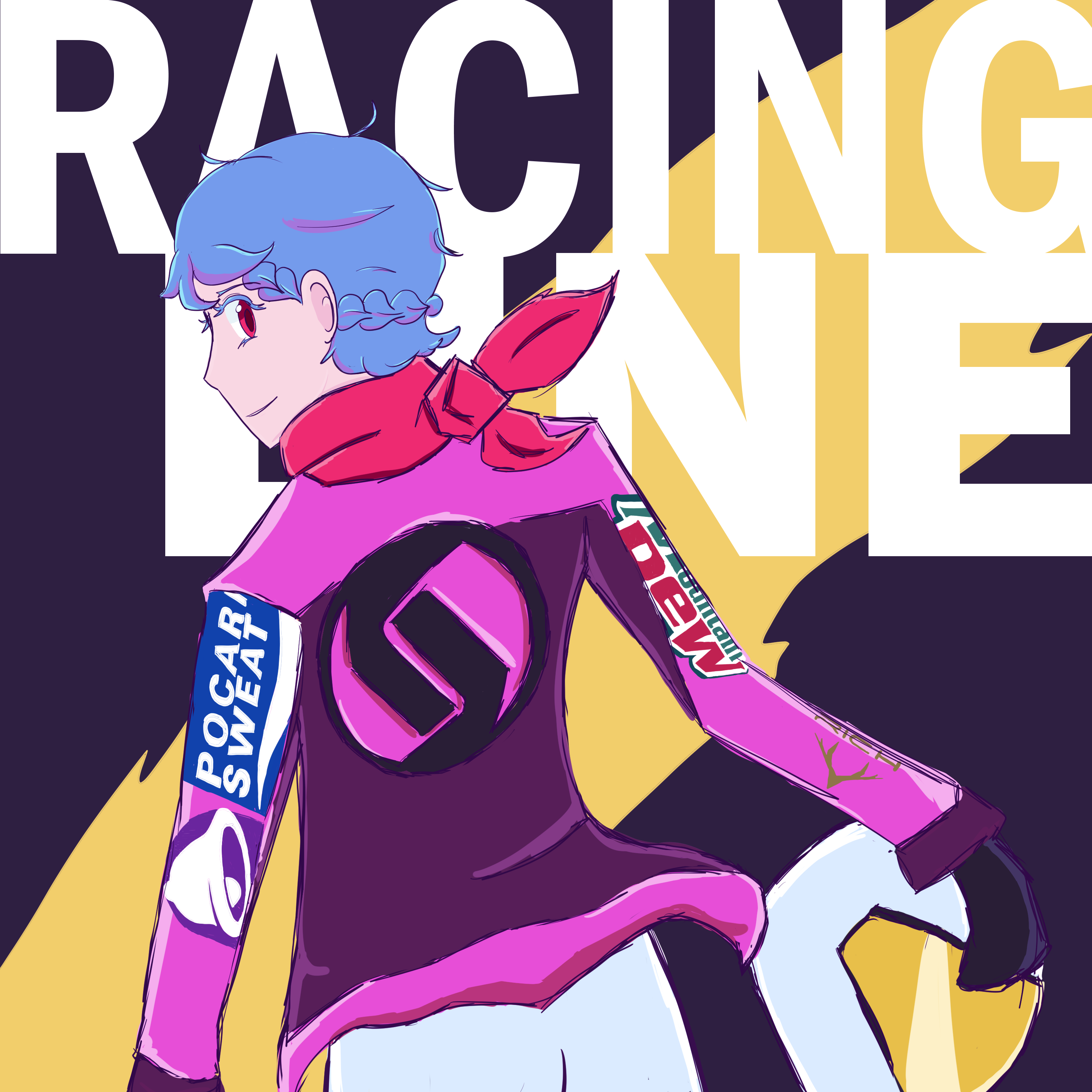
Artist of last year’s Gimmick Awards podcast art, Aleksis Shi, was invited to talk about some of their favorite things of 2025. We are honored by not just their incredible artwork, but the insight they have. Please have a look.
Hullo!
You might know me from the internet from specific places doing specific art on the internet, hopefully memorable ones. Aside from drawing though, I also really enjoy seeking out as much interesting sorts of media that I can and in 2025 I’ve gotten into a lot of different stuff, and watched more movies than I had in previous years, but only ever thought about making a list to talk about them.
I thank Scanline Media for offering me this opportunity, whom without I probably would never be able to share some of these to anyone outside of private life, and honestly I just like the sound of my voice a little too much I suppose hahaha.
This list is in no particular order, and quite a few had to drop out, if only for the sake of brevity and because I don’t necessarily have too much to say (a shame, since I quite liked Algernon Blackwood’s The Willows, Possession, Dogra Magra, and No.51191637 – 无标题 – 都市怪谈 (alternatively called 0[0,1]简寻.《宗神志》)
Runners-up:
Planet of the Apes by Franklin J. Schaffner – Instantly likeable film, the moment you see the apes talking and emoting, when you see them posing for the camera, bantering on animal handling and complaining about unclean work conditions, you just Get it. The film is a timeless old-school scifi classic for a reason, one that did it all and so there’s not much I can really elaborate on hahaha.
Murder on D Street by Akio Jissouji, based on Edokawa Ranpo – Originally this was supposed to be on the list, but I had to make room. Akio Jissouji is known most prominently from his Ultraman work, but you really see his style flourish with the Edokawa Ranpo adaptations. This is a film that is just stylish with a capital S, just a phenomenally directed film with a veteran artist’s hand, a classic piece of psychosexual mystery. This, Human Chair and Dogra Magra really convince me that I should get more into henkaku-style mysteries.
Marebito by Takashi Shimizu – Honestly, this is less about the film itself (which is fairly decent enough), and more just the thoughts it really brought up. Watching Marebito in 2025 felt like a reminder and predictions coming true in many ways. Much like how many a cyberpunk novels predicted the rise of the potential of digital technology and Big Tech for both good and ill, many Japanese denpa works were on the forefront when it came to contemplating the potential social and psychological ramifications of mass communication technology. In fact, works like Marebito, its depiction of that indescribable alienation, dehumanization and loss of self, and interaction through screens and surveillance tools highlight how stories from those Heisei Malaise years not only stood the test of time, but became kinda the pre-emptive thesis statement. One that arguably no other media about the internet even today can really measure up in its viscerality.
My Top 5:

Uncle Boonmee Who Can Recall His Past Lives by Apichatpong Weerasethakul
Uncle Boonmee was a film that occupied my watchlist basically since I first heard of it many years ago. That was back when I was still in Uni, and only now did I get to watch it with my family.
I didn’t know what to really expect, and even as I was watching I wasn’t sure what I actually was taking in. Honestly even by the end I wasn’t sure what to make of it. But then, as I let the film rest in my mind, it grew out of its space, and took more corners of my subconscious. I didn’t realize it at first, I wasn’t thinking about the movie too much, but then I woke up that next day and realized this film has now fully taken life in there in ways only a few can achieve, yet in a decidedly different manner than all the others.
I cannot really describe this film other than it truly feels like an experience that is somehow beyond the confines of its medium.

Death-Duel by Chor Yuen (based on Gu Long’s novel)
70s Shaw Brothers and Gu Long has always been something I’ve known of and existed in the background for me, but never actually delved into it personally, so in 2025 I took the opportunity to delve into both through the Chor Yuen’s adaptations.
Back in the day (at least based on old 老梁 episodes), a general rule was Gu Long novel adaptations succeeded at being films than those of Jin Yong, and this is definitely evident in the Chor Yuen’s Gu Long films. Killer Clans, Magic Blade, Sentimental Swordsman and its sequel are all excellent, but Death-Duel rose to be my favourite.
Gu Long’s wuxia are characterised by a pessimism, where the lawless underworld of jianghu really is a lawless underworld, of crime, murder and betrayal, animated by ever-turning cycles of violence and self-interest. The romanticism of the great martial arts hero is underlined by the loss of normalcy; stuck to be a part of secret plots, death of bystanders, and lost love.
Death-Duel to me represents all of that most succinctly, operatic in how it reaches its conclusion, where single-minded ambition drives everyone to madness, that threatens to swallow all those around it. All leading to that scream of anguish, as everything you try to escape from catches up, forever imprisoning you to it.

Wang Liulang (王六郎); Strange Tales from a Chinese Studio (Liaozhai Zhiyi) by Pu Songling
Another one that’s been in the periphery view is Liaozhai, which like many people I mostly associate with it’s film adaptations like A Chinese Ghost Story. For general interest and as a challenge, I decided to actually pick it up. It’s been more on-and-off read partially due to its anthological nature, and reading Classical Chinese can be quite exhausting esp. If you take breaks in between, which exacerbate how much you can read at a time I hahaha.
Despite any hurdles, Liaozhai is a very celebrated work for a reason, and even just reading a few stories you see the basis of every classical Chinese fairy-tale and ghost story, and despite its age and old Literary Chinese writing style, the book has a lot of humour and genuine bits of humanity, moments that you sometimes forget aren’t just creations of modern storytelling but been weaved in stories since whenever people decided that telling stories is a fun thing to do.
I’d say my favourite so far, and probably a bit of a basic pick, is Wang Liulang. It’s not a scary story, but it’s the one that most exemplifies that humanity. Just a compassionate story of love and friendship beyond life, and kindness being paid forward, that all starts with a simple gesture of charity to those who died in tragedy. Being such a short story, I’d recommend anyone to read it, albeit I don’t know how much of it’s power can still be carried in languages other than the original.

Toys (plus Immortality Drug and Searching a Dream) from the Wisely series / Wisely novels in general, by Ni Kuang
Through making my comic Black Swan Ace, I started to get more familiar with some of the genre’s forebears that I try to evoke, one of them being of course the Wisely book series.
The Wisely series are science-fiction adventure-serial novels by Ni Kuang, one of Hong Kong’s Four Literary Talents (四大才子), and are basically the Chinese take on the various Competent Adventure Man pulp heroes in the vein of Doc Savage, Indiana Jones, Doctor Who and James Bond; Wisely is a writer and adventurer and a fighter (who “went under rigorous training of Chinese martial arts”, as the books will note), passionate and fiercely independent, a man characterized as a youxia in the modern world, dealing with modern issues (so espionage, weird science experiments, supernatural phenomena, and aliens). Very popular back in the day in Chinese-speaking sphere, with a myriad of adaptations in films, TV, comics and a popular radio drama (with a kickass theme song to boot), but virtually unknown in the rest of the world and kind of in the wayside by today.
Wisely has been an oddly wholesome experience for me, just fun old-fashioned pulp adventures. Searching a Dream is an exciting little psychological thriller, while Immortality Drug a straightforward but well-realized mystery adventure with an edge. There is a curiosity and worldly awareness that underlines its big sensational adventures.
There’s this Taiwanese essay by Chih-Chi Chang that I come to agree with; many of those aformentioned Competent Man adventure heroes often carry a perspective informed by their home-countries’ colonial pasts (mainly UK & US), but Wisely adds his own unique wrinkle to this lineage; that being the perspective of Hong Kong when it was under British rule; An Indiana Jones/James Bond-esque hero who instead represents a colonized subject, whose many adventures deal literally and metaphorically with the subjects of colonization and the modern capitalist status quo that it brings. To couple that, the author Ni Kuang was also famously a lifelong anti-Communist Party personage as well, who escaped from them literally twice over, thus the books reflect an overall skeptical view on all hierarchies and the powers that be.
While most stories are far from being the headiest reads (esp. if you are familiar with Ni Kuang’s other writing overall), they’re still mostly adventure novels after all, that dissatisfaction and pessimism over the contemporary world gives it all an edge and rear it’s head in some of the novels, some getting quite indictive even (I wanna say in a way that’s also very characteristically Chinese, that people outside the sphere are not privvy to, hahaha), and leaning towards outright anarchist ideas.

Toys is among one of them, being one of the more immediately engaging stories, and it’s description of humanity’s destiny grim, envisioning the worst possible fate stemming from accelerating technology and industry and human complacency to that status quo.
While the ideas in it are nothing new (though to be fair, the book was also written in 1979), it’s build-up and explanation on what happens in humanity’s future are evocative in the best ways. It is also a book that I like to call “Unfortunately Timeless”; it is to our great misfortune, that the book’s speculations on humanity’s overreliance of computers to the point of mental degradation and subject to mass surveillance has proven to be true in ways that couldn’t have been possible in Ni Kuang’s time, with the onset of LLM and it’s proliferation.
Now I think all that needs to be said about ”AI” and its myriad of problems it’s wrought has been spoken by more eloquent people than me, and so has the statement about the value of art and creativity and life, so I will instead end by stating that this story, this Unfortunately Timeless piece, also speaks for the value of curiosity and desire to learn.
While Ni Kuang couldn’t have predicted its exact machinations, his own stated desires to carry that spirit of curiosity and discovery for the Wisely novels assures it’s immortality. As long as people can maintain that same sense of wonder, they will always carry that spark of life brighter than any other.

Ryu’s Road by Shotaro Ishinomori
I’ve been a huge Shotaro Ishinomori fan since I’ve watched Cyborg 009 on Finnish TV that one summer, and followed up on watching Kamen Rider. Yet, so many of Ishinomori’s works have gone untranslated and unnoticed by many parts of the world, so any Ishinomori work available is a rare treat.
Ryu’s Road is a comic that I admittedly finished rather late, and reading it now felt like discovering a Rosetta’s Stone of sorts. Ryu’s Road feels a magnum opus kind of work, encompassing not only many of Ishinomori’s thoughts and themes into one package, but also many of the older science-fiction works that preceded and inspired it, with his brilliant artwork and storytelling. The story isn’t completely flawless; it never really figures out what to do with its principal female character and the story does seem to lose direction majorly during its second-to-last stories, it sticks to the landing with a great finale that lives up to it’s grandeur and all the decades of sci-fi stories it’s following. It is as much Planet of the Apes or 2001: A Space Odyssey, as it is many modern manga like Heavenly Delusion and Fire Punch.
This is a comic which sensibilities, pacing and conveyance could legitimately come out 20 years ago or even 10 years ago, and not feel dated in anyway, demonstrating once again how much of a pioneer and trailblazer Shotaro Ishinomori was in the art of comics.


A satire as well as an ode to humanity and life.
We are grateful Aleksis took the time to write this, and we are honored we get to share this with you as well. If you want to follow Aleksis on social media, you can follow them on Bluesky, Tumblr, and Instagram. If you want to support them more directly, consider purchasing some of their comics on itch.io or backing them on Patreon. And of course, they provided the album art from last year so it is the header image of this article, so please consider browsing their portfolio.